


Keratosis pilaris
rough bumps on your upper arms
Keratosis pilaris is a harmless and often hereditary skin condition. The bumps can lessen over the years, but they do not disappear on their own in everyone.
We treat it with peels and targeted care that dissolve the build-up of keratin. Scrubbing does not work here: the plugs sit around the hair follicle and not at the surface.
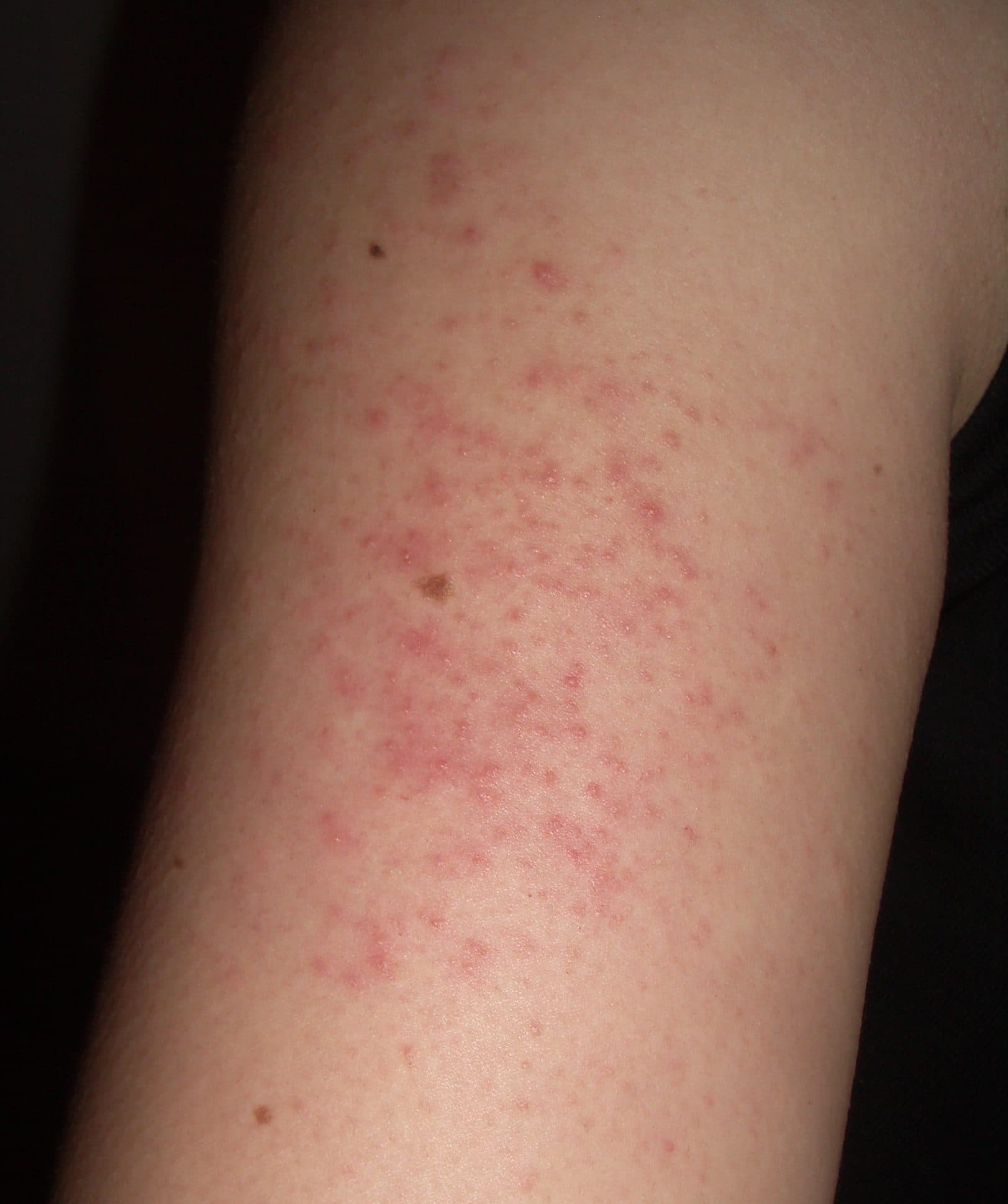
Keratosis pilaris, the goosebump skin on your arms, is harmless and often hereditary. At Diba Clinics in Rotterdam we treat it with medical peels, from € 140, and targeted skincare that dissolves the keratin build-up. Scrubbing does not work, because the plugs sit around the hair follicle. The bumps can become fewer, but do not disappear for everyone. A skin therapist first checks whether it is keratin build-up or dry skin.
What the skin therapist
looks at
Keratin build-up and dry skin look alike and ask for different treatments. These are the three things the skin therapist tells them apart by.
How the bumps feel
Keratin build-up feels like fine sandpaper and sits fixed in the pore. Dryness feels rough, but rubs away.
Whether it is on both sides
Keratosis pilaris is almost always symmetrical. If it is on one side or on shaved areas, it is something else.
How it runs across the year
Clearer in winter and calmer in summer fits keratin build-up. With dryness it virtually disappears in summer.
Four pictures that
feel rough
Keratin build-up, dryness and ingrown hairs feel almost the same under your hand. Where it sits and whether it is symmetrical makes the difference.
Rough bumps on your upper arms
keratosis pilaris- How you recognise it yourself
- Does a large area feel like sandpaper, are the bumps close together, and is it roughly the same on both arms?
- What it is
- Keratin build-up around the hair follicles: a plug of horny cells forms above each hair. Harmless, largely hereditary, and in many people it lessens over the years.
- What we do
- Gradually making the top layer suppler and the plugs looser, at a pace your skin can handle. Maintenance belongs with it; this is not a course with an end point.
Keratin build-up around the hair follicles. Not curable, but it can be made suppler and less red, with the maintenance that belongs to it.
Red cheeks with small bumps
keratosis pilaris rubra faciei- How you recognise it yourself
- Is the redness on the cheeks or along the jawline, with tiny bumps in it, and has it been there for as long as you can remember?
- What it is
- The same keratinisation, but on the face and with more redness around it. It is often mistaken for acne or rosacea and is neither.
- What we do
- More carefully than on an arm, because facial skin reacts more strongly. First the redness, only then the texture.
Keratin build-up around the hair follicles. Not curable, but it can be made suppler and less red, with the maintenance that belongs to it.
Rough from dryness
xerosis- How you recognise it yourself
- Does it feel rough without you being able to feel separate bumps, and does it largely disappear if you moisturise properly for a while?
- What it is
- Dry skin and not keratinisation around the hair follicles. This looks like it and calls for something far simpler.
- What we do
- Nothing drastic. Restoring the barrier and keeping it up; if it goes away from that, this is what it was.
Not keratosis pilaris but dryness or ingrown hairs. Both call for something simpler or for a different page.
Bumps with a hair in them
pseudofolliculitis- How you recognise it yourself
- Are the bumps mainly on shaved areas, and in bright light can you see a dark loop under the skin?
- What it is
- Ingrown hairs, and not keratosis pilaris. The difference lies in the location and in whether there is a hair in it.
- What we do
- That is a different story with a different treatment, and there is a page of its own for it.
Not keratosis pilaris but dryness or ingrown hairs. Both call for something simpler or for a different page.
Then this is not your page.
Bumps in shaved areas with a dark curl beneath are ingrown hairs. That is a different indication and a different treatment.
What helps and what we advise against
This is a condition that comes with maintenance. With a series of treatments and the right care you keep it calm.
This works
- Saying honestly that this cannot be cured, and what can be done instead
- Making the top layer suppler gradually, at a pace the skin can handle
- Maintenance you can keep up yourself, because without it the picture returns
- Tackling the redness separately, because it often bothers people more than the bumps themselves
- Taking into account that it is worse in winter; that is not a relapse but the season
We advise against this
- Scrubbing. The plugs sit around the hair follicle and not at the surface; you only make the redness worse
- Squeezing or picking. That leaves you with dark marks and sometimes dents
- Presenting a course of treatment as a definitive solution. Keratosis pilaris usually asks for lasting care and maintenance.
- Promising that the skin becomes smooth. Suppler and less red is realistic
- Treating it as acne. There is no inflammation and no bacterium in it
What we use for this
Medical peels
from € 140From light to strong. The strength decides how deep it goes and how much you flake.
Frequently asked questions
What is keratosis pilaris?
A harmless and often hereditary skin condition. A small plug of keratin cells forms over each hair. It feels like fine sandpaper, usually on your upper arms and sometimes on your thighs, buttocks or cheeks.
What can you do yourself about keratosis pilaris?
Don't scrub and don't pick. Moisturise every day, because drier skin makes the build-up of keratin more visible. A cream with urea, lactic acid or salicylic acid softens the outer layer of skin; which one suits you, you hear at the intake.
How do I get rid of keratosis pilaris?
A cure is not possible, but in many people it lessens on its own over the years, often from around thirty. In the meantime the picture can be softened. That is not a pretty story, and it is the honest one.
Why does scrubbing not work?
Because the keratin build-up sits around the hair follicle and not at the surface. So you scrub over the bumps rather than into them. What you do achieve is more redness and a damaged barrier.
What causes keratosis pilaris?
It is largely hereditary and it has nothing to do with hygiene, food or how you care for your skin.
Why is it worse in winter?
Cold air and indoor heating dry the skin out, and drier skin makes the keratin build-up more visible and rougher. In almost everyone it is less in summer. That is the season and not a relapse.
What does a treatment for keratosis pilaris cost?
A medical peel costs from 140 euros. Which strength and how many treatments suit your skin, you hear during the consultation. It costs 50 euros; if you have a treatment in the same appointment, that amount comes off again. Maintenance is part of it; this is not a course with an end point.
What we establish first
For most people the most useful outcome is that it has a name, is harmless and is not their fault. What can be softened besides that, we discuss in the same conversation.
Book a consultationNot sure yet? Ask your questionPhoto at the top: Irja, CC BY-SA 2.0, via Wikimedia Commons.