

Acne that keeps
coming back
Acne comes in different forms, and each form asks for a different approach. We first work out which one you are dealing with and treat that, with peels, needling, laser or a combination.
Is it mostly what has been left behind? Then it starts with acne scars, because that is often not a scar at all.
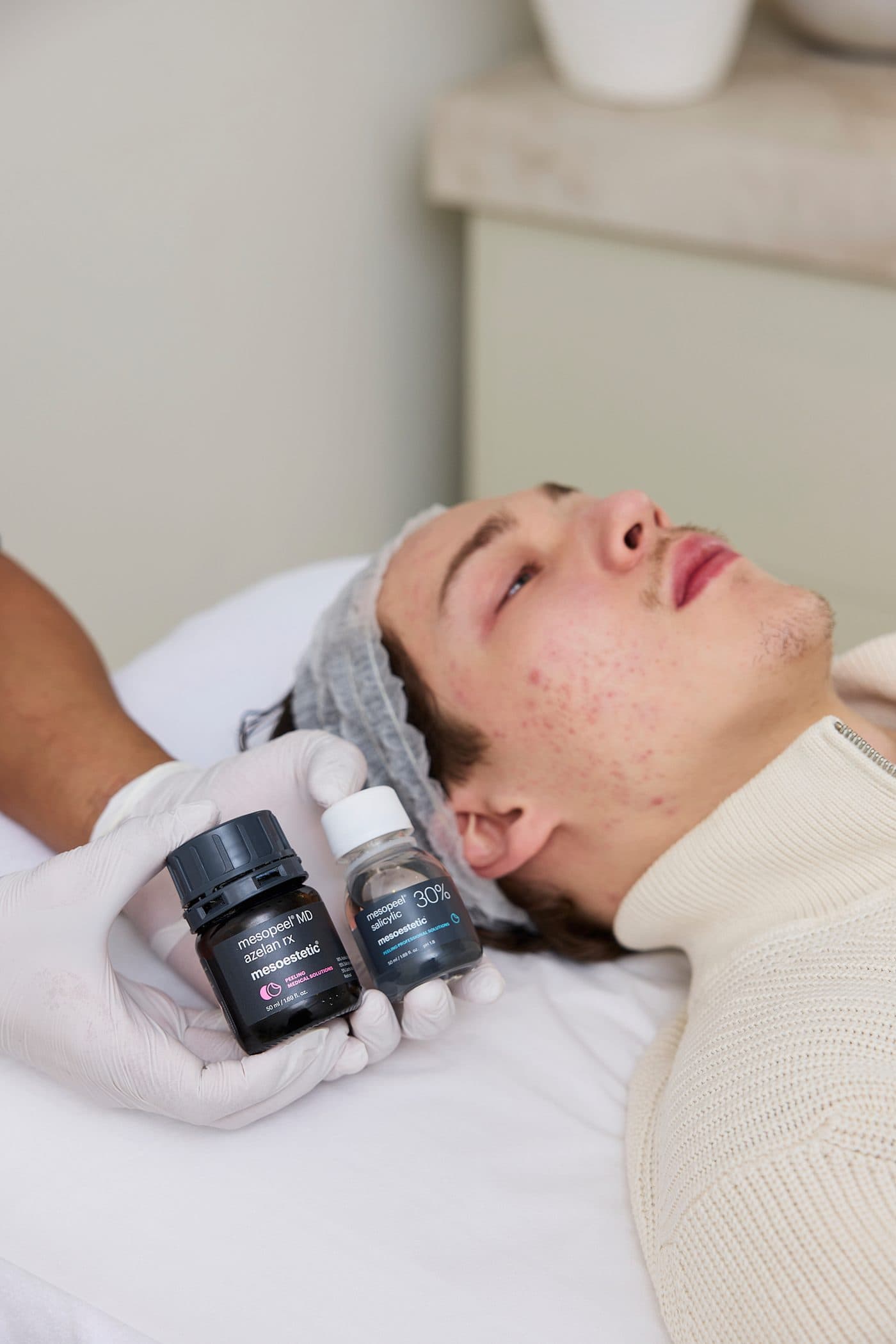
At Diba Clinics in Rotterdam, acne is treated by a skin therapist. Clogged pores and blackheads are emptied under sterile conditions, and for inflammation we work with chemical peels, from € 140, and the herbal peel, from € 150. If acne keeps coming back, there is the acne programme of three to six months for € 570, with products and check-ups. Medication goes through your GP or dermatologist.
Where it sits
says what it is.
The jawline points to something different than the T-zone. On the cheeks it can come from outside, from your phone or your pillowcase, but it can just as well be hormonal. And acne on your back, shoulders or chest is a zone of its own, with its own cause. Tap where yours sits and we read along. You can pick more than one.
More about acne on your back and shouldersMore than one is fine. The place often says more about the cause than how bad it looks.
Outside the face
Hover over a zone to read what it usually means on its own. Tap it to count it in the reading beside this.
Tap where it sits
You can choose more than one zone. Where acne sits often tells you more about the cause than how it looks.
If you cannot point it out well, we go through the zones together at the consultation.
This is a reading of a pattern, not a diagnosis. Two people with the same zones can get a different plan. That is why we measure before we treat.
Which acne do you have?
Acne is not one thing. The type decides what actually helps, and with one of these five it decides that you belong with a doctor rather than with us.
Blackheads, little redness
comedonal acne- What you see
- Skin that feels rough when you run a hand over it. Open blackheads with a dark head and closed ones you mostly feel. Little redness, hardly any pain.
- What it means
- The pore is blocked, but your immune system has not stepped in yet. This is the stage where you can prevent the most rather than repair.
- What we do first
- Cleaning the pores and working on the build-up of keratin, in steps and without irritating the skin. This is often the course with the fewest sessions.
Those dark dots are not dirt. It is sebum that has discoloured in the air. That is why scrubbing does not get it out.
Red bumps and whiteheads
papulopustular acne- What you see
- Raised, red spots that are tender when you press on them. Some with a white head. Usually in waves, often across cheeks and chin.
- What it means
- There is active inflammation, and we can do something about that. We treat this form with peels: chemical peels and herbal peels, which calm the inflammation and work against bacteria. Laser and needling wait until the skin is calmer.
- What we do first
- Inflammation down, with the peel that suits your skin. Only once the skin is calmer do we look at texture and scars. That order is not negotiable.
A white head is not a sign that it is ripe for squeezing. It is a sign that your immune system is already at work.
Deep, painful nodules
nodulocystic acne- What you see
- Swellings you feel more than you see. They do not come to a head, they hurt, and they more often leave a scar or a dark mark.
- What it means
- We can treat this form. For some people medication is needed as well, and that comes from a doctor; we then treat the skin and take into account what the doctor has prescribed.
- What we do first
- An honest conversation. If the lumps hurt, stay for weeks or leave scars, we advise you to see your GP first. Sometimes our advice is not to start with us yet.
With this form your immune system is at work deep in the skin. That is not because you are doing something wrong and it is not a matter of cleansing better.
Mostly on chin and jawline
mandibular acne- What you see
- A fixed pattern along the jawline and chin that flares up around a fixed period in the month. Often deeper and more tender than the rest.
- What it means
- The pattern over time points to a hormonal factor. Skin treatment improves the picture, but the cause often lies deeper.
- What we do first
- We ask about your cycle, the pill and any PCOS. Skincare and a medical programme reinforce each other here; if the cause lies with your hormones, we advise you to discuss that with your GP.
Hormonal acne is not just for teenagers. We see it just as often in people in their thirties and forties.
From friction or contact
acne mechanica- What you see
- Spots under a face mask, a helmet strap, a sports bra, or on the cheek where your phone sits. Often sharply bounded along the edge of that contact.
- What it means
- The cause is pressure, heat and moisture, not your skin type. Without removing the cause it comes back, however well we treat it.
- What we do first
- First working out what comes into contact with your skin. Then calming it down. Sometimes this can be solved without a single treatment, and we say so.
This has nothing to do with hygiene. We see it in people who wash twice a day.
Acne runs through several stages
At each stage you can do something different. That is why scrubbing harder does not work: it acts on the second stage and makes the fourth worse. Click through and see what changes.
Stage 1 of 4
Sebum
Your skin shines sooner than you want, mostly on your nose and forehead.
The sebaceous gland sits deep in the skin and makes oil that travels up along the hair shaft. Under the influence of hormones it makes more than the skin can clear.
Creams do little about the production itself. What does work is improving the way out, so that it does not sit there.
Keratin build-up
The skin feels rough. You see small bumps without redness.
Dead skin cells do not shed properly at the edge of the pore and stick together. The opening narrows and eventually closes off.
This is where most of the gain is, and where it most often goes wrong. Scrubbing too hard damages the barrier and makes the last stage worse.
Bacteria
Nothing yet. This happens below the surface.
There is no oxygen left in that closed-off pore. A bacterium that always lives on your skin suddenly has room there.
This is not a question of dirty or clean. The bacterium belongs to your skin; only the conditions have changed.
Inflammation
Red, raised, tender. This is what you see in the mirror.
Your immune system is clearing up. The redness and the swelling come from your immune response and not from the bacterium itself. That is why a spot feels warm.
Now the goal is calm. Anything that irritates extends this phase. Squeezing pushes the inflammation deeper and that is the shortest route to a scar.
What helps and what we advise against
On the left what we do with acne, on the right what we advise against. Each point says why, because nobody remembers a “do not” without a reason.
This works
- A skin analysis before we start, so that we can measure later under comparable conditions
- Cleaning pores and working on keratin build-up, in steps your skin can take
- Inflammation down first, with chemical peels and herbal peels that are also antibacterial. Scars after that, never at the same time
- Sun protection, every day, in winter too. This prevents the dark marks that stay behind after a spot
- Referring you to a doctor when the picture calls for it, even though you came to us
We advise against this
- Toothpaste or lemon juice on a spot. It irritates the skin and leaves a dark mark more often than the spot itself would
- A sunbed. It hides redness for a while and damages your skin in the meantime
- Scrubbing every day. You take away the barrier that is meant to limit the inflammation
- Alcohol toners that make your skin feel tight. Dehydrated skin makes more sebum, not less
- Squeezing it yourself. You push the inflammation deeper instead of out. This is the fastest route to a scar
Why we start
with the inflammation
Treating scars on skin that is still inflamed makes the picture worse. So we settle the inflammation first and work on the scars after that. That order gives more than trying both at once.
The inflammation first, the scar after
Lasering or needling in active acne makes the inflammation worse and can set a scar. We wait until the skin is calm before we start.
Medication goes through your doctor
Acne medication comes from your GP or dermatologist. We adjust our treatment to what your doctor has given you.
No fixed number of sessions in advance
How many sessions you need depends on your skin and how it responds. So we do not promise a number beforehand: we measure along the way, and we stop if it is not working.
These are the things we follow with acne
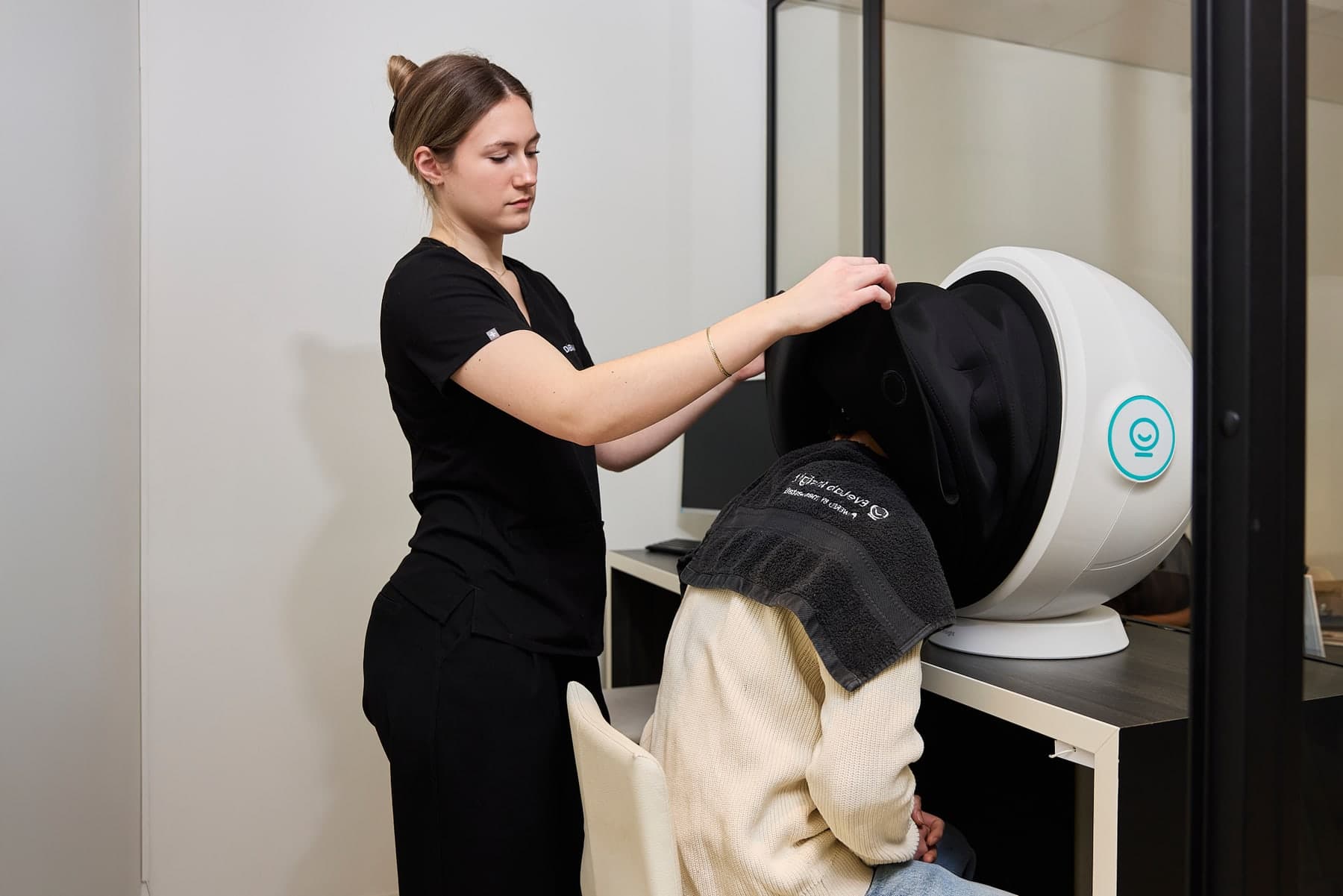
The EVE-M measurement records your skin before we start. With acne, pores, inflammation, redness and texture are the axes that count. After eight to twelve weeks we measure again and put the two side by side.
That is not to convince you. It is so that we can see it when something is not working, and do something else.
Pores
Size and density, measured rather than estimated
Redness
How much active inflammation is visible and where
Texture
Unevenness, and whether scars are starting to form
What we use for this
Medical peels
from € 140From light to strong. The strength decides how deep it goes and how much you flake.
Herbal peel
from € 150A peel of finely ground herbs, without acid. It calms the inflammation and works against bacteria.
Fotona Acne Control
On requestLaser for active acne, aimed at the inflammation and the sebaceous gland.
LED therapy
€ 30Light that calms the skin. In several wavelengths, without needles or acids.
Acne treatment
On requestOne appointment for unsettled skin: cleansing, clearing blockages, calming. Bookable on its own.
Acne programme
€ 570A guided programme for acne: treatments at the clinic, products and check-ups at home.
Teen acne programme
€ 297A guided three-month programme, set up for young people up to and including eighteen.
A blood test that maps which foods your body reacts to.
Frequently asked questions
Will this get rid of my acne?
For most people acne can be kept under control. For some it keeps coming back, because of hormones for instance. We say beforehand what we think is realistic in your case, and we measure whether it works. Control is sometimes the honest goal, and that is not second best.
How many sessions do I need?
That depends on the type of acne, how long it has been going on and how your skin responds to the first treatments. After the skin analysis you hear what we expect and what a session costs, but we cannot promise a fixed number beforehand.
I have tried everything. Why would this work?
Honestly, we do not know that yet. That is why we start by measuring rather than treating. If we think it will not work here, we would rather say so now than after six sessions.
Can I keep using make-up?
Yes. We do look together at what you use, because a few common products keep the picture going without you noticing.
Can I come if I am under a dermatologist?
You can, and it is often sensible. Do tell us, so that we can work out what combines safely with your medication.
Does it help if I change my diet?
Sometimes. We work with a laboratory and can do a food intolerance test; if something comes out of it, changing your diet really does have an effect. Without that test it stays guesswork, and we are not going to talk you into a diet here.
It is mostly the marks that are left behind.
Those are usually not scars but pigment marks. Sun protection stops them getting darker and stops new ones appearing, but it does not remove a mark that is already there; that needs treatment. If there is a dip in the skin, then it is a scar, and we look at it as soon as the skin is calm.
What does acne treatment cost?
The acne programme costs 570 euros. It includes the treatments in the clinic, the check-ups and the products for home. On their own, a herbal peel costs 150 euros and a medical peel from 140 euros. Which route suits you, you hear during the consultation. It costs 50 euros; if you have a treatment in the same appointment, that amount comes off again.
What others
say about it.
These come from Salonized and were not picked by us on content: they are the reviews in which acne, spots or congestion come up. Watch the time mentioned in them, because with acne that is what it is about.
Reviews translated from Dutch.
“The stars at Diba are so friendly! I never let anyone but Diba treat my skin, and I'm rid of my long-term acne.”
BusraVisit to Diba ClinicsOver 4 years ago “I felt the therapist had taken the time to remove the blemishes. And she involved me in the process of what the steps were.”
MalikaVisit to Diba ClinicsOver 6 years ago “Had a dermapen and carbon laser appointment yesterday. My skin already feels smooth and the spots are reducing already. Really lovely ladies too!”
JennaMicroneedlingAbout 7 years ago
Book a consultation
at Diba Clinics
At the consultation we measure your skin, talk through the type, and you hear what we expect and how we measure it along the way. Including when the answer is that you are better off waiting.
Book a consultationNot sure yet? Ask your question