


Moles:
what to look out for
We don't remove moles, not even when they bother you. If we notice something during a treatment or a consultation that needs to be assessed, we tell you, give advice and refer you to your GP.
That's where it belongs: only a doctor can have tissue examined, and that can't be done afterwards. What you can do yourself is know what to look out for.
We don't remove moles.
If we notice something, we refer you to your GP and give advice. Your GP can refer you to a dermatologist if needed. If a mole is in an area we're treating, we cover it.
Six things to look at.
Five letters dermatologists use, plus a sixth that most sites leave out. Go through it before you make an appointment. It gives no verdict and can rule nothing out; it helps you decide whether a doctor should look first.
- A: Asymmetry
Fold the spot in half in your mind. Do the two halves match?
A quiet mole grows evenly from one point and is therefore usually roughly symmetrical.
- B: Border
Look at the edge. Is it smooth and clear, or ragged and vague?
The transition to ordinary skin says something about how the spot behaves at its edges.
- C: Colour
Does the spot have one colour, or several shades mixed together?
Different colours within one spot are one of the best-known reasons to have it checked.
- D: Diameter
Is the spot larger than a pencil eraser, about six millimetres?
Size on its own says little. It mostly counts alongside the other points, and a small spot that changes matters more than a large spot that has been the same for years.
- E: Evolving
Has anything changed in shape, colour, size or feel in recent months? Think of itching, bleeding or a scab that does not go away.
This is the most important point of the five. Change counts for more than how the spot looks, even when the other four show you nothing unusual.
- The ugly duckling
Put this spot next to your other moles. Does it look like the rest, or does it stand out?
One person's moles usually look alike. So one that clearly stands out is worth checking, even if on its own it seems nothing special.
Go through the points above. Whatever you fill in, the outcome of this check is never a verdict on your spot: it only helps you decide whether to take it to your GP.
This check is information and not a medical examination. It cannot see what a doctor sees with a dermatoscope, so it can rule nothing out. When in doubt the advice is always the same: have it checked.
What helps and what we advise against
The first cross on the right is the only one on this site that is not about money: having something removed that is changing means there is nothing left to examine.
This works
- Looking yourself once a month, preferably at the same moment. It is about change, and you only see that if you have a picture in your head.
- Taking photos of spots you are watching, up close and with something beside them for scale.
- Looking where you do not look automatically: your back, your scalp, between your toes and under your nails.
- When in doubt, to your GP. That is what the surgery is for.
- Taking sun protection seriously, because this is the subject that is not about your looks.
We advise against this
- Having something removed that is changing, anywhere. What is gone cannot be examined. That is the one step you cannot make up for later.
- Burning or freezing it off yourself with something from a shop. The same objection, with more damage.
- Waiting until it hurts. Most suspicious spots do not hurt at all.
- Going by a photo app or a verdict from the internet. A screen sees no depth and no change.
- Thinking it is only about your face. Spots on the back, legs and soles of the feet are the most often overlooked.
What we do and don't do
We don't remove moles. This is what does happen if you come to us with a mole.
We don't remove moles
Not even when it bothers you. Assessing and removing belongs with a doctor, who can have the tissue examined.
If we notice something, we refer you on
If we notice something about a mole during a treatment or a consultation, we tell you, give advice and refer you to your GP. Your GP can refer you to a dermatologist if needed.
We cover moles up
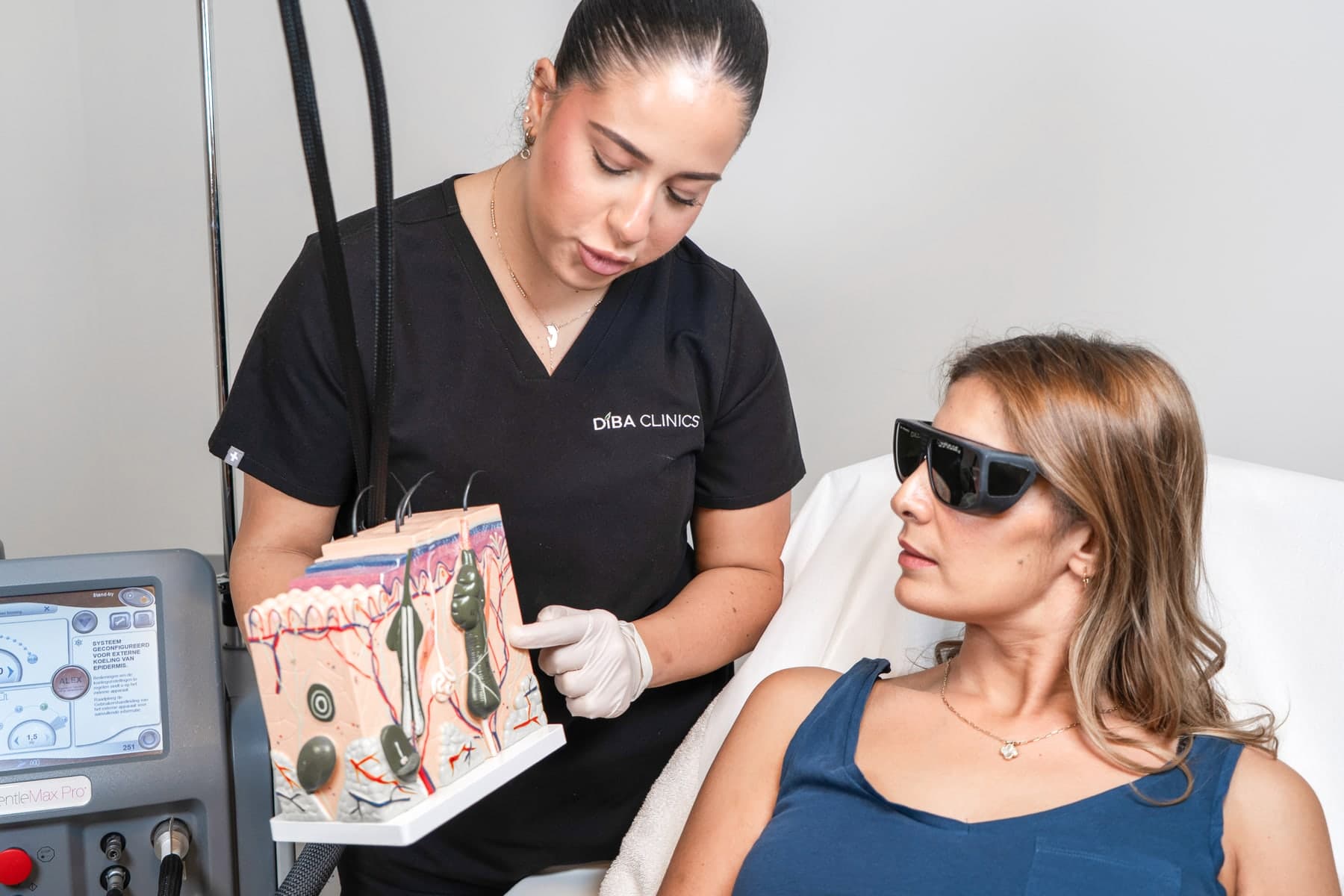
If we laser nearby, a cover goes over it. Light on pigment can change the picture, and then a later assessment no longer holds.
Frequently asked questions
Then why is this page here at all?
Because people ask us this during a treatment, and because you lie in our chair with your skin in full view. We want you to know what to watch for and where to go, even when it is not us.
Can I have a mole removed at your clinic?
No. Not with a suspicious spot and not with one you simply want gone. That goes to your GP, who can do it or refer you on.
I have a treatment booked and there is a mole in the area.
Then we cover it. That takes half a minute and it means a doctor can still assess later what is there.
Do I get new moles from sunbathing?
Sunlight plays a part in new spots forming and in the risk of skin cancer. Exactly how large that part is differs per person and is not something we put a number on.
How often should I check myself?
Once a month is common advice and mostly practical: often enough to notice change, rare enough to keep up. Ask your GP what is sensible in your case.
For the mole itself, see your GP
If you come for something else and there's a mole in the area, we cover it and carry on. If it's about the mole itself, your GP is the place to go. They can refer you to a dermatologist if needed.
Do we notice something?
Then we tell you, give advice and refer you to your GP.
Is it in the treatment area?
Then we cover it and carry on with the treatment.
Do you want it removed?
Your GP does that, or a dermatologist through a referral. We don't remove moles.