

Treating rosacea: skin that
keeps flaring up
Rosacea is a long-term condition that can be steered well. With the right treatments and care your base colour settles, you flare up less often and the vessels become less visible.
Do you mostly see separate vessels and no flare-ups? Then it is probably couperose. They often go together; the skin therapist assesses under magnification which one you are dealing with.
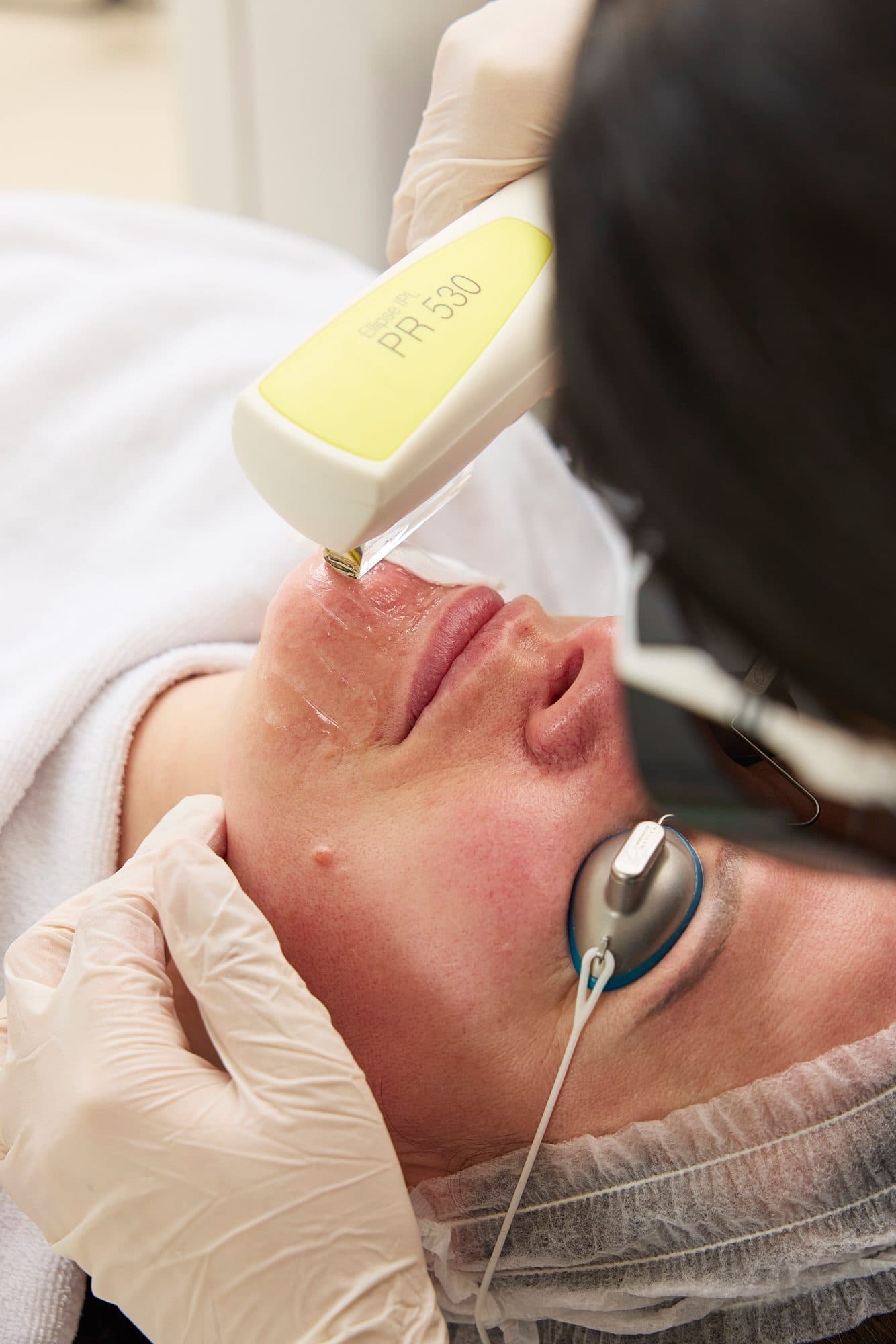
At Diba Clinics in Rotterdam we treat the redness and visible vessels of rosacea with IPL: per session € 75 for the nose, € 150 for the cheeks, € 200 for cheeks, nose and chin and € 250 for the whole face, in a series of three to six with maintenance afterwards. LED therapy, from € 30, calms the skin. Rosacea can be managed, not cured. The skin therapist first looks at what irritates your skin, and with inflamed bumps a doctor is sometimes involved.
Which triggers
you can steer yourself
You already knew wine makes you red. The question that counts is how many of your triggers you can influence and how many you cannot, because that ratio decides whether habits or treatment gives you the most. Tap what you recognise.
You have a say in these
You can change something about these triggers, and that often gives you the most.
- Nothing in this group yet.
These are out of your hands
These triggers are hard to avoid. Treatment can then help to keep the symptoms under control.
- Nothing in this group yet.
Tap what makes you red
Pick everything you recognise. It is about the ratio: how many of your triggers can you influence yourself?
Not sure? Keep track of it for two weeks. That gives you more than any test.
Book a consultationThis is not a diagnosis and not a test. It is a way to see your own pattern before you walk in here, so that the conversation does not start from zero.
Which form of rosacea
do you recognise?
Rosacea has stages that ask for a different approach. With two of them our answer is that you belong with a dermatologist. So that is what it says, because that is quicker than a course of treatment here first.
Flushing that lingers
flushing- What you see
- Waves of redness across cheeks, nose and forehead. At first it fades; later a base colour stays behind.
- What it means
- The vascular response is overactive but there is no lasting damage yet. This is the best moment to step in.
- What we do first
- Mapping the triggers, and only then looking at whether the vessels need treatment. This is often the stage with the fewest sessions.
This is not sensitive skin from the wrong products. It is a vascular response, and that does not change with a different cream.
Visible vessels
telangiectasia, thread veins- What you see
- Thin, permanently visible blood vessels. They do not disappear when you press on them and do not go away by themselves.
- What it means
- These vessels are permanently dilated. They respond well to treatment, but new ones can appear as long as the triggers continue.
- What we do first
- This is the picture where treatment achieves the most. We first measure how much is visible, so you do not have to take the difference on trust later.
Thread veins are not the same as rosacea, even though they often go together. You can have the veins without the rest.
Red bumps on a red base
papulopustular rosacea- What you see
- Bumps and pustules, but without blackheads. That last part is what distinguishes it from acne.
- What it means
- This belongs with a doctor. There is medication for it that works well, and we work alongside it.
- What we do first
- We refer you on and coordinate. If we treat this as acne, it gets worse, so we do not.
Without blackheads it is almost never acne. That is the quickest distinction you can make yourself.
Thickened skin on the nose
rhinophyma- What you see
- A gradually thicker nose with coarser pores, mainly in men.
- What it means
- An advanced stage in which connective tissue has increased. This belongs with the dermatologist.
- What we do first
- Here we refer you on, because the right treatment lies outside our practice.
This has nothing to do with alcohol, however persistent that story is. That prejudice gets in many people's way for years.
Rosacea or acne?
This is what goes wrong most often, and it is not harmless: treating rosacea as acne makes it worse. Four differences you can check yourself.
Blackheads
Present with acne, absent with rosacea. The quickest difference.
Where it sits
Acne on the jawline and forehead, rosacea in the middle of the face.
Flushing
Flaring up is part of rosacea; it is not part of acne.
What scrubbing does
With acne sometimes something. With rosacea it makes things worse.
If after reading this you think you have acne after all, then the other page is where you belong, and that is not a detour but the shortest route.
To the acne pageWhat helps and what we advise against
With rosacea the first point on the left is free and often gives you the most. That is not the answer a clinic is supposed to give, but it is the right one.
This works
- Keeping track of your triggers for two weeks before you buy anything. This is free and gives you the most
- Sun protection, every day. With rosacea, UV is both a trigger and an accelerator
- Lukewarm showers and rinsing your face lukewarm. Unappealing advice, large effect
- Products without alcohol and fragrance, and no more than three steps
- Referring you to a doctor when bumps appear
We advise against this
- Treating it as acne. Scrubs and drying products demonstrably make rosacea worse
- Sauna, hot showers and steaming. Heat is the strongest trigger there is
- Trying new products all the time. Every change is another stimulus for skin that already overreacts
- Covering it with a thick layer and then not cleansing. That gives you a second problem
- Expecting it to go away. Rosacea can be controlled, not cured, and we would rather say that now
With rosacea, redness is what counts.
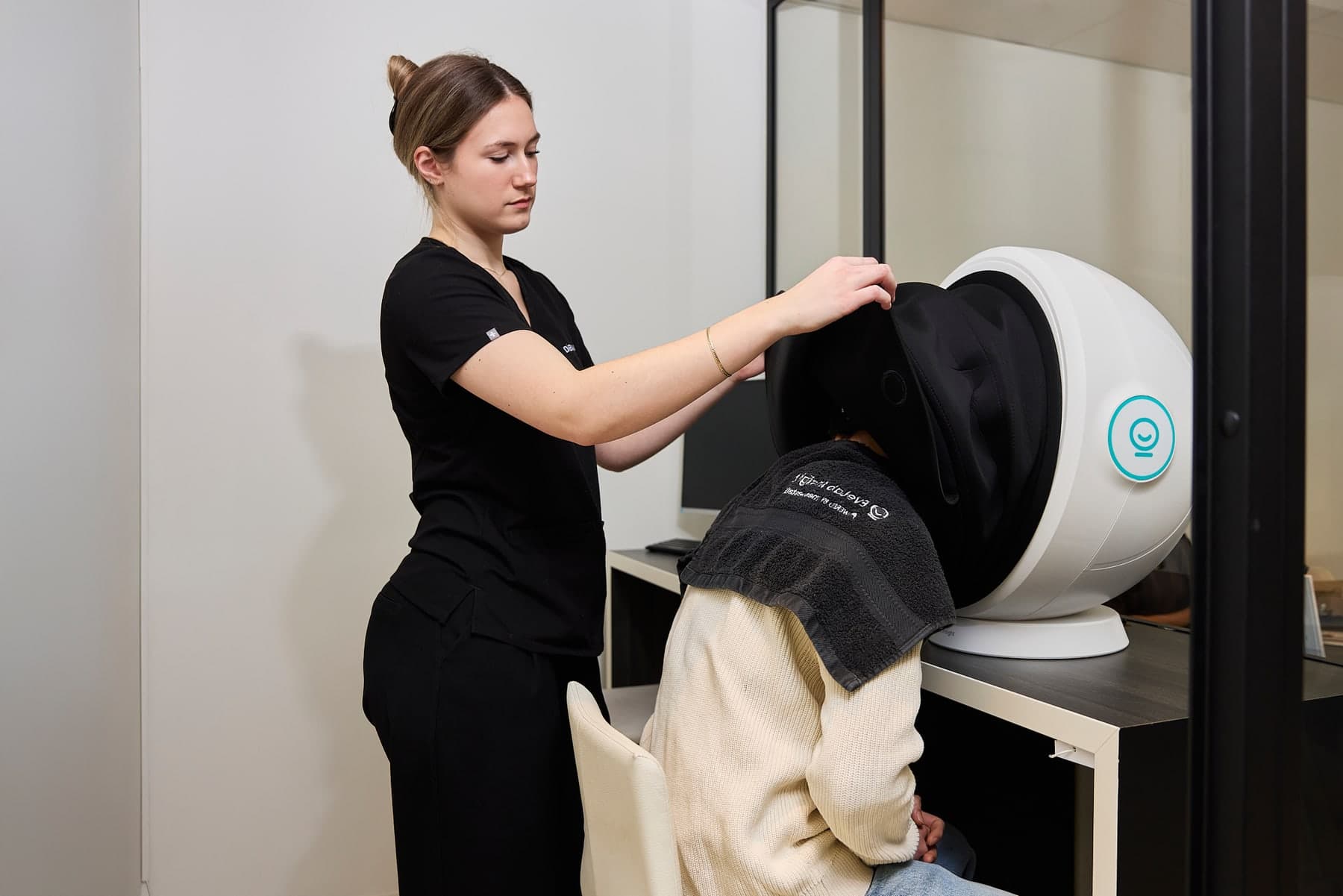
Redness is the kind of thing your eye gets used to. That is why we measure it: not to convince you, but so that we can see the difference on a day when you think nothing has changed.
We also measure the visible vessels separately, because they respond differently than the base colour does.
More about the skin analysisWhat we measure here
- Redness
- The base colour of your skin, apart from a flare-up
- Vessels
- How many are visible and where they sit
- Barrier
- How reactive your skin is at this moment
Every axis is measured again at each check-up, under the same lighting. That way a difference later is something you see rather than something you have to take on faith.
What we use for this
Nordlys IPL for redness and vessels
from € 75Light on visible vessels, rosacea and lasting redness. The vessel darkens and then fades.
LED therapy
€ 30Light that calms the skin. In several wavelengths, without needles or acids.
A blood test that maps which foods your body reacts to.
Frequently asked questions
Can rosacea ever go away?
No, rosacea is long-term. What is possible: fewer flare-ups, fewer visible vessels and a calmer base colour. For most people that is a large difference in how they feel.
What causes rosacea?
With rosacea, the blood vessels in your face overreact, and what sets off that reaction differs from person to person. Heat is the strongest trigger there is; others are alcohol, spicy food, hot drinks, perfume in your skincare, sun, cold and wind, stress and hormones. Some of these you can control, some you can't. Keeping track for two weeks of what makes you flush is what helps most.
What helps best against rosacea?
Knowing what makes you flush: keep track of your triggers for two weeks. Also sun protection every day, lukewarm showers, and products without alcohol and perfume, no more than three steps. With visible blood vessels, treatment usually achieves the most. If bumps appear as well, that belongs with the doctor: there is medication for it that works well.
How do I know it is rosacea and not acne?
The quickest difference: acne has blackheads, rosacea does not. Rosacea also sits more in the middle of your face and comes with flushing. You only know for certain after an assessment.
Do I have to give up wine and spicy food?
That is your choice, not our prescription. We do tell you what it does, and then you decide what it is worth to you. For some people it makes a big difference, for others little.
Does laser help against the vessels?
With visible vessels, treatment usually gives the most of everything we do. New vessels can still appear as long as the triggers continue, so maintenance is part of it.
Can I still exercise?
Yes. Stopping exercise is not advice we give. We look at timing, cooling and what you do afterwards.
I am embarrassed that I go red so quickly.
We hear that often, and it is the reason people wait for years. You do not have to explain anything here. We look at your skin, not at your behaviour.
What does rosacea treatment cost?
At Diba Clinics in Rotterdam, an IPL session with the Nordlys for redness and vessels costs 75 euros for the nose, 150 euros for the cheeks, 200 euros for cheeks, nose and chin, and 250 euros for the whole face. Usually a series of three to six sessions is needed, four weeks apart, so for the whole face it comes to 750 to 1,500 euros. With rosacea, maintenance follows. The consultation costs 50 euros; if you have a treatment in the same appointment, that amount comes off again.
Book a consultation at Diba Clinics
At the consultation we measure your redness, go through your triggers and you hear what is realistic in your case. Including when that means you belong with a doctor.
Book a consultationNot sure yet? Ask your question