


Scars and stretch marks
that stay visible
With scars and stretch marks the age decides what is possible. Red and purple scars generally respond best; with white scars we focus on the texture and the relief. At the intake the skin therapist assesses which stage it is in and which treatment belongs with that.
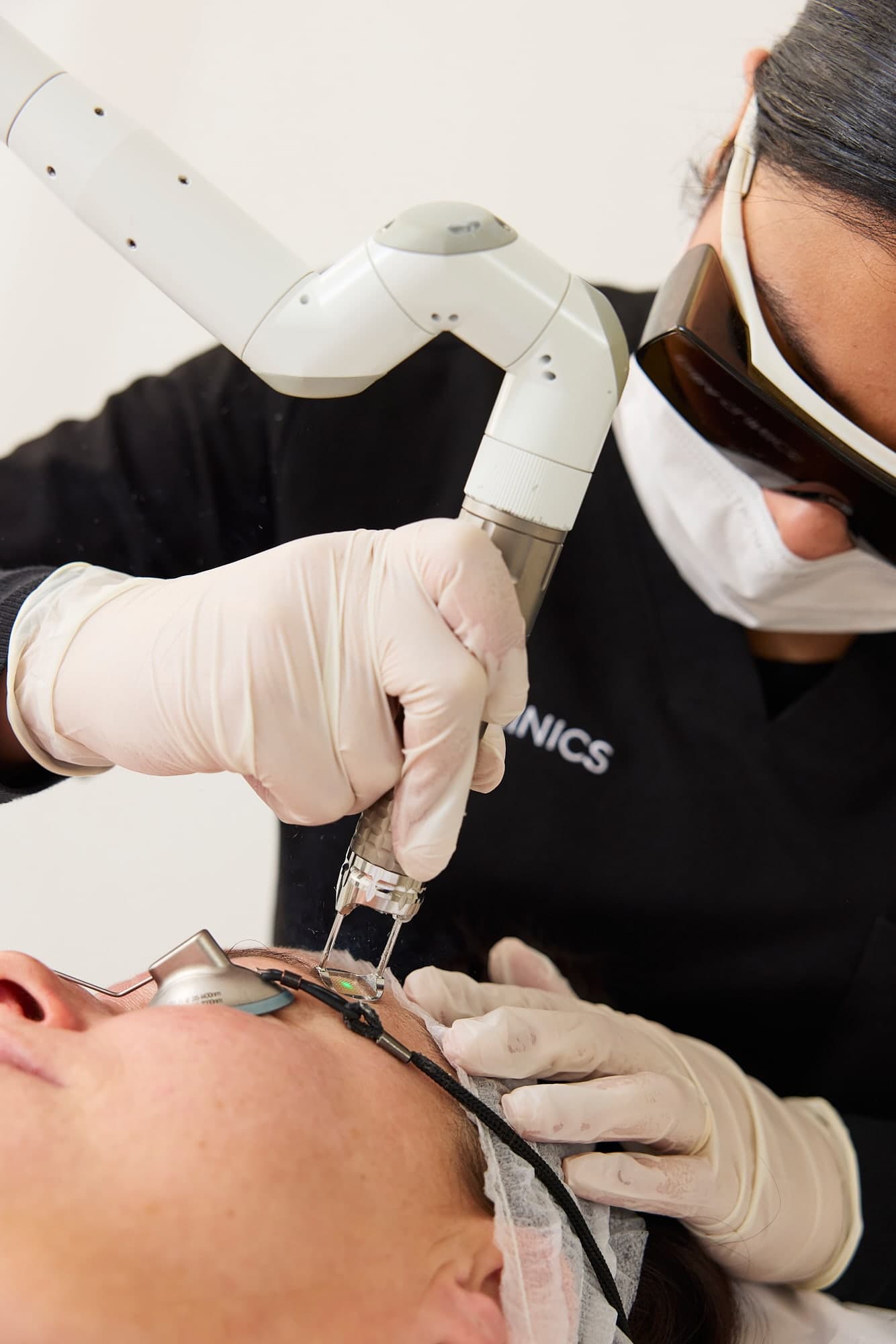
At Diba Clinics in Rotterdam we treat scars after surgery or a caesarean section with scar therapy, from € 100 and € 125 for a caesarean scar, and sunken or uneven scars with microneedling from € 180 or with laser, Fotona Scar Repair, € 195 per session. How old a scar is determines what is possible: a young scar needs a different approach than a mature one. It is usually a series of three to six sessions.
How old it is
decides what is possible.
Slide to how long you have had it. The colour in the drawing changes with you, and the answer gets blunter the further you go. Scars and stretch marks follow the same axis.
This is the period in which you can influence the most.
The bar is not a measurement but a proportion: it shows how the room to change something shrinks as a scar gets older.
Just appeared
- What happens in your skin then
- The wound is closed but the skin is still clearing up. Red, sometimes raised, often tender. New blood vessels are forming and collagen is being laid down without order.
- What is realistic
- There is nothing to treat yet, and that is good news. What you do now determines how the scar will look, more than any session.
- What we would do
- We do not treat. We tell you what to do at home: keep it out of the sun, do not pull on it, and be patient. That costs you nothing and gains you the most.
3 to 12 months
- What happens in your skin then
- The collagen is being rearranged. In this period the scar can still go either way: flatter and lighter, or thicker if production overshoots.
- What is realistic
- This is the window. Here there is the most to gain, with scars as well as with red stretch marks. Anyone who comes now comes at the right moment.
- What we would do
- Measure and then treat in a targeted way. With red and raised scars we often work on the blood vessels first, then on the texture.
1 to 3 years
- What happens in your skin then
- The redness fades and the scar becomes paler. The tissue becomes firmer and less mobile. The shape is now largely set.
- What is realistic
- There is still something to gain, especially in texture. The colour follows on its own. Expect improvement, not disappearance.
- What we would do
- We first measure whether there is enough to gain to justify the sessions. If not, we say so.
3 to 5 years
- What happens in your skin then
- The scar has matured. The blood vessels have largely gone and the collagen is in its final state. Naturally, almost nothing changes any more.
- What is realistic
- Texture can still be improved, pits partly filled. Colour is difficult: white tissue no longer produces pigment.
- What we would do
- Honest arithmetic. We show you what the measurement says and what that means in sessions, and then you decide whether it is worth it to you.
Older than 5 years
- What happens in your skin then
- White, thin and permanent. With stretch marks this is called striae albae. The tissue lacks pigment cells and has a different structure from the skin around it.
- What is realistic
- Here the honest answer is that we can promise little. The texture can be partly improved, the white colour hardly at all. So we do not promise complete disappearance here.
- What we would do
- Usually we advise against it, or we suggest a short trial with a measurement afterwards. Then you see for yourself whether carrying on is worthwhile.
Not sure exactly how old it is? Look at the colour. Red means young, white means old. That is more accurate than your memory.
Which kind of scar
do you recognise?
Dents respond best. Raised scars and keloids belong with a doctor. And with stretch marks the colour matters more than the place. Pick what comes closest to you.
Dents in the skin
atrophic scars- What you see
- Small dips, often on the cheeks and temples. They stand out in light from the side and far less straight on.
- What it means
- Tissue was lost during healing. The skin around it is normal.
- What we do first
- This type responds best of all scars. We work on the edge of the dent, not on its floor.
These are not large pores. A pore is round and has an opening; a dent does not.
Raised, firm scars
hypertrophic scar, keloid- What you see
- Raised tissue, often redder and firmer than the skin around it. With keloid it grows beyond the original wound.
- What it means
- Collagen production has overshot. Keloid belongs with a doctor and not with us.
- What we do first
- With keloid we refer you on. With hypertrophic scars we look at it with you, often in consultation with your doctor.
Keloid is more common on darker skin. That is linked to predisposition and not to skincare.
Red or purple stretch marks
striae rubrae- What you see
- Red to purple streaks, often on the stomach, breasts, thighs or lower back. Sometimes slightly raised, sometimes a little itchy.
- What it means
- The skin has been stretched faster than it could grow with it. Red means it is recent and that there are still blood vessels in it.
- What we do first
- This is the moment when stretch marks respond best. Waiting until they are white is the most common mistake.
Stretch marks are not a sign that you did something wrong. They go with growth, pregnancy and building muscle, and athletes get them too.
White stretch marks
striae albae- What you see
- Pale, slightly sunken streaks that catch the light.
- What it means
- The stretch marks have matured. The tissue lacks pigment and is thinner than the skin around it.
- What we do first
- Here our answer is often that the gain is limited. We show that with the measurement instead of asking you to take our word for it.
Creams that promise to remove white stretch marks do not do that. You see that in the measurements too.
If a scar grows beyond the edge of the wound it is a keloid and the treatment goes through your doctor. What we do in that case is on Keloids and raised scars in Rotterdam.
The step everyone
wants to skip.
Almost nobody comes here for step one. Yet it decides whether the rest makes sense, because treating scars in inflamed skin produces new scars.
Calm first
As long as there is active acne or inflammation, you are adding scars rather than removing them. This is the step people want to skip.
Then measure
We record how deep and how extensive it is. Scars change slowly, so without a measurement you cannot see later whether it worked.
Then treat
Targeted treatment, with an agreed number of sessions and a moment at which we look again. If it does not work, we stop.
And then protect
A treated scar stays more sensitive to the sun for a while. Without protection you trade the scar for a dark patch.
Do you still have active acne? Then step one belongs on the acne page, and only after that here. That is not a detour but the shortest route to fewer scars.
To the acne pageWhat helps and what we advise against
The first cross on the right is the most expensive mistake on this page, and it costs nothing to avoid: waiting until it is white.
This works
- With a fresh scar: out of the sun, every day, for a year. This is the cheapest treatment there is
- Coming in time. Red and young responds better than white and old, and that matters more than the choice of treatment
- Calming the acne or the underlying problem first, and only then the scar
- Measuring before we start, because scars change slowly and your eye gets used to them
- With stretch marks in pregnancy: waiting until after breastfeeding and then measuring
We advise against this
- Waiting until it is white. That is the most common mistake, and then there is little left to do
- Treating scars while the acne is still active. Then you are making new ones
- Creams that promise white stretch marks will disappear. That does not happen, whatever the price
- A sunbed to camouflage the difference. Scar tissue does not tan, so the difference only grows
- Sanding or pricking it yourself. You are making a new wound where the old one was
With scars, depth counts.
Scars change slowly. So we record the starting situation and compare it after a while with a fresh assessment.
With stretch marks we also measure the colour, because it tells us which phase they are in and so what is still possible.
More about the skin analysisWhat we measure here
- Texture
- How deep the dents are and how extensive
- Colour
- Red, pink or white: that decides the phase
- Surface
- How large the area is that we treat
Every axis is measured again at each check-up, under the same lighting. That way a difference later is something you see rather than something you have to take on faith.
What we use for this
Microneedling with the SkinPen
from € 180Medically certified microneedling. It works on the layer where the structure of your skin sits.
Dermapen 4
from € 180Microneedling with vibrating needles that pass through the skin evenly.
Fotona TimeWalker
from € 150Fifteen treatments on one device, from a light laser peel to the complete 4D. Each with its own purpose.
FRAC3
On requestA fractional laser that goes deeper, for texture, pores and irregularities.
Fotona Scar Repair
€ 195Laser on scars: acne scars, surgical scars and stretch marks.
Scar therapy
from € 100For scars after surgery or a caesarean. The price follows the length of the scar.
What others
say about it.
These come from Salonized and were not picked by us on content: they are the reviews that mention scars. They are about programmes lasting months, and you hear that in them.
Reviews translated from Dutch.
“Very happy overall. I came in the first time with a lot of blemishes and scars and I can say with positivity that my face looks very even and lovely.”
BraysonVisit to Diba ClinicsAbout 6 years ago “Had a really lovely Hydrafacial treatment. I have such a lovely glow! My scars have been treated for the first time too so I'm looking forward to the progress of this process :) Thank you dear Rojda.”
ElifHydraFacialAlmost 4 years ago “I've been by 3 times now for the diode laser and I genuinely see an 80% difference! The scars and spots on my skin have hugely improved too thanks to the dermapen. A forever regular anyway!!”
SaraLaser hair removalOver 7 years ago
Frequently asked questions
Can I remove a scar myself?
No. Rubbing or pricking it yourself makes it worse: you create a new wound where the old one was. What you can do yourself with a fresh scar: keep it out of the sun, every day, for a year. With fresh, raised scars silicone can do something; with old ones it can't.
What is the best treatment for scars?
How old the scar is matters more than the technique. Indented scars respond best; for those we work with microneedling or laser. Scars after surgery or a caesarean section we treat with scar therapy. Raised scars and keloids belong with the doctor.
Will my scars disappear completely?
No. A scar is permanent tissue; what we do is make it less noticeable. With fresh scars that difference is large, with old ones small. We say beforehand which category yours falls into.
I have stretch marks from pregnancy. Can I come already?
You can always come, and measuring too. We prefer to treat after breastfeeding. If your stretch marks are still red, this is the best moment to have the conversation, because that window is closing.
Why does my acne have to be calm first?
Because treating inflamed skin can give new scars. You would be paying for a treatment that makes the picture worse. That is why we sometimes say no to someone who came especially for it.
Do those scar creams from the chemist work?
With fresh scars silicone can do something, especially with raised scars. With white stretch marks and old scars it does not. The price says nothing about that.
I am ashamed of my stretch marks when swimming.
We hear that often, and it is a real reason to come. We are just not going to pretend we can make them vanish. What we will do is say honestly how much difference there is to expect in your case.
How many sessions do I need?
That depends on the age of the scar and the type. After the measurement you get a number and a price, and a moment at which we look again at whether it is working.
My caesarean scar still hurts after years. What can I do?
Have a scar that still hurts after years assessed by your GP first. The scar itself is treated by a skin therapist at Diba Clinics in Rotterdam with scar therapy, 125 euros per session for a caesarean scar, usually three to six times with four to six weeks in between.
What does scar treatment cost?
Scar therapy starts at 100 euros; the price follows the length of the scar. Microneedling with the SkinPen or the Dermapen 4 costs from 180 euros per session and Fotona Scar Repair 195 euros. How many sessions you need, you hear during the consultation. It costs 50 euros; if you have a treatment in the same appointment, that amount comes off again.
Young scars respond best
With a red scar or red stretch marks this is the moment when it matters most. With old scars we work out honestly whether it gives enough.
Book a consultationNot sure yet? Ask your question